 Next.js
 PostgreSQL
 Prisma
 Socket.IO
The problem
At the end of the night, a restaurant owner in Pakistan often can't say what was actually sold. Orders were taken in one system, stock was tracked in a paper register, and salaries were worked out by hand at the end of the month. Every report meant collecting numbers from three places, and a short cash drawer was found weeks later, if at all.
The software on offer didn't fit how these restaurants work. Most point-of-sale systems are built for steady internet, English menus and card payments. Here, the connection drops in the middle of the dinner rush, menus are written in Urdu, regulars and suppliers run on khata (credit kept in a notebook), and the kitchen works from paper tickets.
So the brief was simple to say and hard to build: one app that runs the whole restaurant, keeps taking orders when the internet is down, prints on the cheap thermal printers restaurants already own, and reads in Urdu.
RFC, the first customer
RFC serves karahi, BBQ, burgers and pizza on Main Faisalabad–Lahore Road in Manawala. It was the first restaurant to run on Munshi, and it still does.
- 10,500+ orders taken on Munshi
- 163 orders on its busiest day
- 9 staff on attendance and payroll
- Running on Munshi since September 2025
Switching over. Munshi was built alongside RFC's own counter and kitchen, so every screen was tested in a real rush before it shipped. Staff moved over one area at a time: the counter first, then the kitchen tickets, then purchases and payroll. The restaurant never had to stop and switch everything at once.
Now. Every order, ticket, purchase and shift lives in one place. The drawer is counted every night, so a shortage shows up the same day instead of weeks later. Khata balances for regulars and suppliers update themselves as bills and payments go in. Salaries come straight out of the attendance the staff already mark, so nobody works out payroll by hand.
My role
Munshi is mine end to end: I decide what to build, design the screens, write the code, ship it and support the restaurants that use it.
- Product. I built it from RFC's counter, watching orders go through in a real rush and then fixing whatever slowed the staff down.
- Design. Every screen is made for a cashier in the middle of a rush, with Urdu names beside the English ones.
- Engineering. 50+ data models, 100+ database migrations and over 1,000 automated tests.
- Running it. Deploys, onboarding new restaurants, and the call when something goes wrong.
I use AI coding tools to move faster. The design decisions, code review and testing stay with me.
How it works
What people use
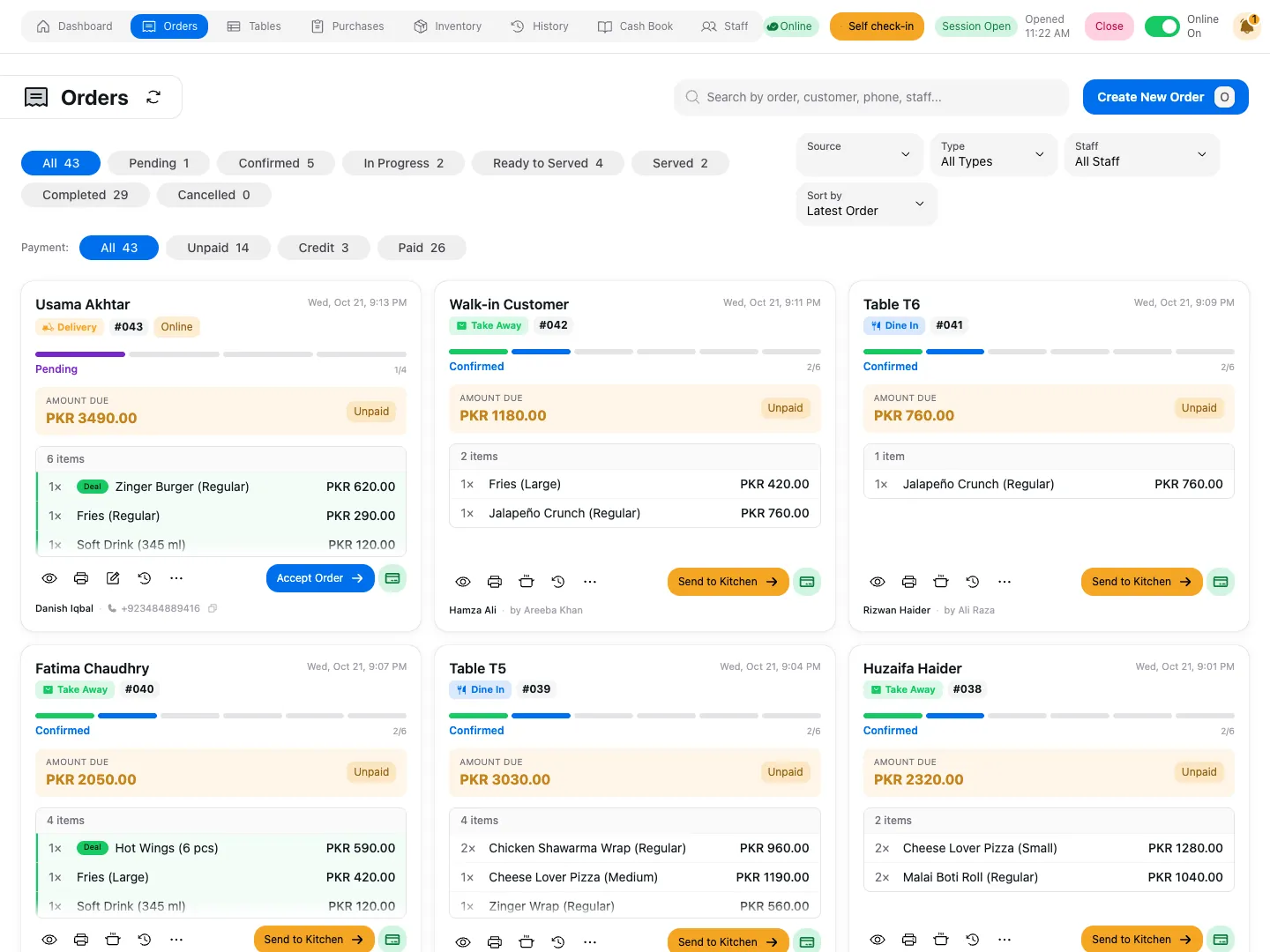
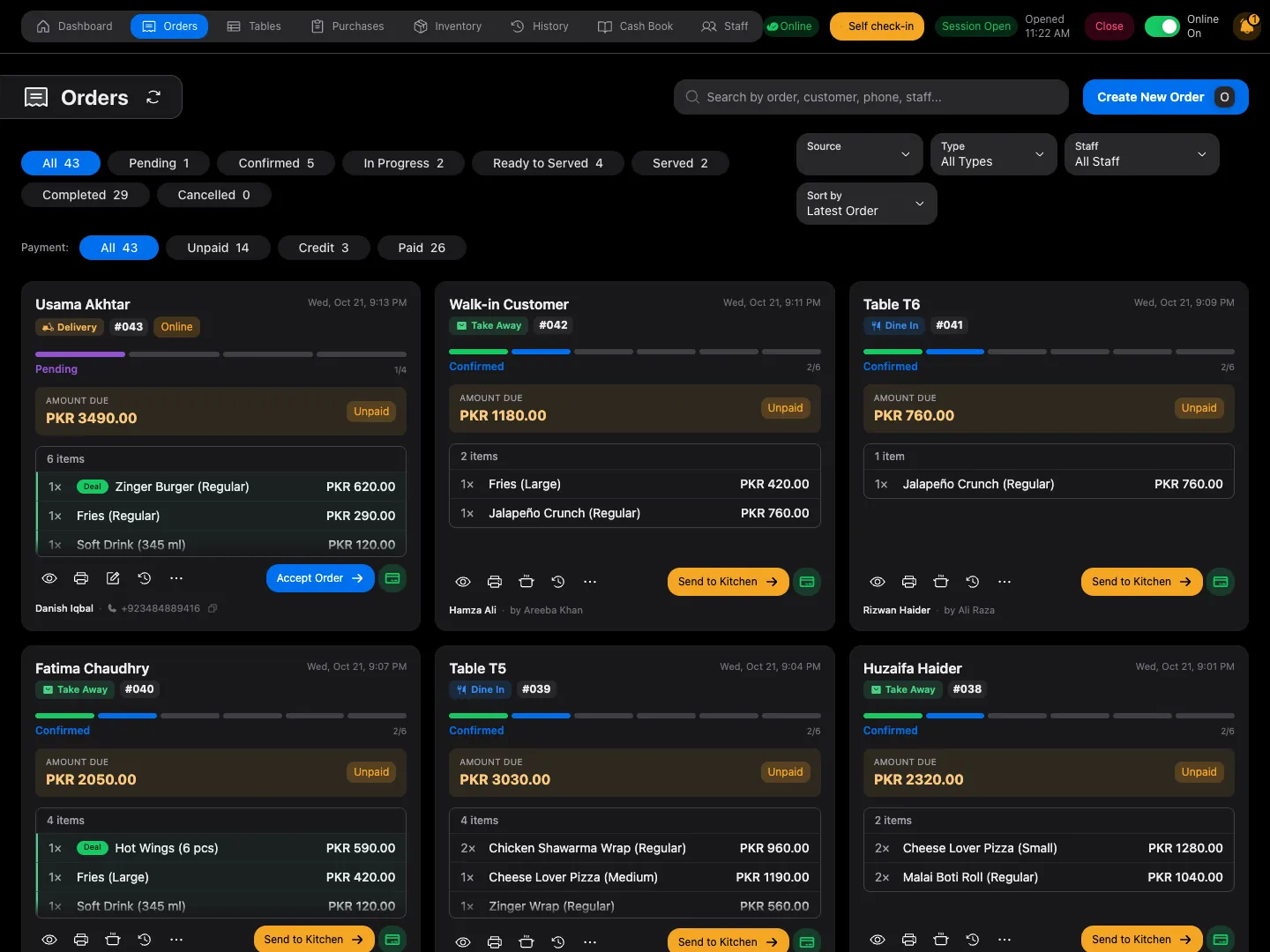
- Orders: dine-in, takeaway and delivery, plus an online ordering page for each restaurant. Bills, payments and kitchen tickets, including tickets for changes to an order.
- Kitchen: a live display that updates on every screen as orders change.
- Stock: products, variants and recipes, so selling a dish takes its ingredients out of stock. Intake, adjustments and waste.
- Staff: roles the owner designs, attendance, and payroll worked out from it.
- Cash and khata: opening and closing the drawer, expenses, and running balances for regulars and suppliers.
- Branches and reports: each outlet runs on its own. Managers see theirs, owners see all of them, with sales and menu reports across branches.
Under the hood
One Next.js app on PostgreSQL through Prisma, with a small realtime server beside it (Socket.IO) that keeps the counter, kitchen and admin screens in sync and runs the scheduled jobs.
- Every restaurant lives in one database and gets its own subdomain.
- Staff sign in with an outlet code, a staff code and a PIN. Permissions are set per role and per outlet.
- Bills, kitchen tickets and tokens print through the browser, sized for 80mm thermal paper.
- It installs like an app and keeps working offline. That part has its own story below.
Decisions
All restaurants share one database. Munshi first ran each customer on its own server and database. Onboarding a restaurant was a manual job of about three days, and every update had to be rolled out once per customer. I moved everyone onto one shared database before the third customer arrived, while the move was still cheap. Now adding a restaurant is a single step, and one migration updates everyone. The cost: keeping one restaurant's data away from another's is the code's job, not the database's. That's why a suite of 19 test files exists only to try to reach one restaurant's data from another.
Printing goes through the browser. Bills, kitchen tickets and tokens are laid out in the browser and sent to whatever printer the computer already has, so there's nothing to install at the restaurant. The receipt is built from order data already on the device, which means printing keeps working when the internet is down. It also solved Urdu for free: the browser draws the text, so Urdu prints like any other script, which is hard with raw printer commands. The cost: tickets can't yet be routed automatically to a separate kitchen printer. I'll add direct printer commands when a restaurant actually needs that.
Each restaurant gets its own subdomain. Browsers tie sign-in cookies, the offline cache and the installed app to a domain, not a path. Two restaurants on one address would share a cookie jar and install the same app icon. A subdomain each keeps them apart, even on a shared device. The server works out the restaurant from the address itself and ignores any restaurant the browser claims to be. Branches share their restaurant's subdomain; staff reach their outlet through the code they sign in with.
Urdu names are data, not translation. A restaurant's Urdu menu isn't a translation of its English one: چکن کڑاہی is simply the dish's name. So each dish and category carries its own Urdu name, and each restaurant picks English, Urdu or both, with right-to-left text only where Urdu appears. It took one database column instead of a translation framework. The cost: buttons and labels are still in English, and a fully right-to-left interface waits until a restaurant needs it.
The hard part
Taking orders with the internet down. Picture a full night, and the connection drops. The cashier has to keep ringing up orders and the kitchen has to keep getting tickets. When the internet comes back, every one of those orders has to reach the server exactly once: none lost, none counted twice.
At first the app opened offline and let a waiter build a whole order, then failed at the moment of saving, with no warning. That was worse than an outage, because it lied until the money was on the counter.
The fix is an outbox on the device. An order taken offline is saved locally with a temporary number like #TMP-4F2A, its bill and kitchen ticket print straight away, and a background loop sends the backlog whenever the server can be reached. When the order lands, its card quietly becomes #014.
The traps were in the details:
- The browser said we were online.
navigator.onLineonly knows the Wi-Fi is up. At RFC the router stayed connected with a dead line behind it, so the app now checks whether the server itself answers. - The cache was too helpful. The service worker's default setup cached every API response for 24 hours, so a stale answer could make the app look online, and staff could see day-old data. API calls now always go to the network.
- Retries must not double orders. Every queued write carries an idempotency key, so the server recognises a resend and does the work once. Some refusals really mean "already done", like cancelling an order that's already cancelled, and count as success.
- Not every failure is the same. No network or an expired sign-in pauses the queue, a server error backs off and retries, and a real conflict is parked for a person to fix. A background sync never throws a waiter onto the login screen in the middle of service.
- Two tabs, one queue. A browser lock stops two tabs from sending the same orders, and editing an order that hasn't synced yet rewrites it in the queue instead of queueing behind it.
What it taught me: offline isn't a feature you add at the end. It changes what every write has to promise.
Another one, briefly. One day a manager couldn't sign in, and nothing anywhere said why. Granting their role one more permission had pushed the sign-in token past 4 KB, and browsers silently drop a cookie that large. I cut the token from about 4 KB to 3.4 KB and added a check that warns long before the limit.
Outcome so far
RFC has run on Munshi since September 2025, and the numbers above are its own. Moving every restaurant onto one database changed what growth costs: adding a new restaurant went from about three days of manual setup to under five minutes.
What I'd change: I'd test offline mode on real restaurant hardware sooner. Half of its scenarios have so far only been tested in the browser. And I'd add CI instead of relying on the check script I run before each deploy.
What's next: the restaurant system is the first of a family of management systems built on the same foundation. Grocery management comes next.